


Yesterday we completed 100 years since the birth of the legendary filmmaker Ritwik Ghatak (4 November 1925 – 6 February 1976). Many consider him to be one of the greatest filmmakers of the world. Ghatak’s one-time students in FTII - Mani Kaul, John Abraham, and especially Kumar Shahani carried Ghatak’s ideas and theories into their films. Rajat Kapoor has been inspired by Mani Kaul, Kumar Shahani and the legacy of great independent cinema continues… I spoke to Rajat in episode number 35 (in 2017) about independent cinema and thought of revisiting the conversation in this week’s samachar celebrating centenary of Ghatak.
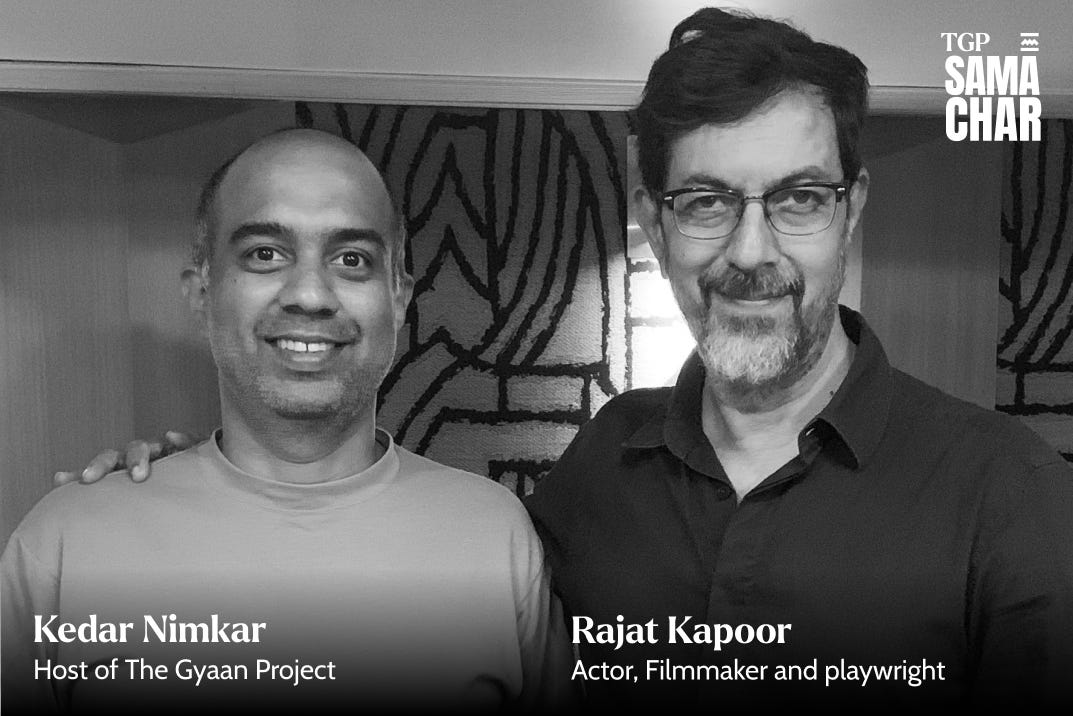
Rajat Kapoor is a celebrated Indian actor-filmmaker and playwright, known for his work since the 1990s. Raghu Romeo, Aankhon Dekhi, RK/RKay and more are all time great watch. We spoke deeply about art, challenges of independent cinema and his films. If you’re a young Indian filmmaker, art-student, designer or creative curious about cinema beyond the mainstream, today’s SamaChar will give you a sneak peak into our long conversation (which I highly recommend listening). But for now, here are 4 Q&A from our talk.

1️⃣ What is independent cinema to you?
Short answer: Honesty and authorship.
Long answer: Independent cinema is independent in thought. It is not defined by money, stars, or distribution but by the filmmaker’s vision. That’s the real mark. You can recognize a Van Gogh painting instantly because it carries his signature. Similarly, when you watch a Coen Brothers film or something by Nolan or Woody Allen, you know it’s theirs. Even if they work within a studio, their authorship remains. That’s independence. If a film feels like anybody could have made it, it has no identity. Independence means the director’s vision shapes every frame, even within constraints. It’s not about scale or glamour but about honesty and authorship. The film should bear the unmistakable stamp of its maker.
2️⃣ Why do we need independent cinema?
Short answer: Rice and Rose.
Long answer: Why does art exist? You can get by without it, but life would be dry. It’s like rice and a rose. Rice keeps you alive, and the rose tells you how to live. You don’t need art for sustenance, but you need it for everything beyond the body and the mind. Why do you look at a tree or the sea for hours? Because beauty enriches you in ways that are not tangible. Art fulfils that spiritual need. If cinema changes people in a short run, it’s propaganda. Good cinema puts you in an universe and enriches your soul in long run giving joy and meaning. Without it, life would be empty.
3️⃣ What has been the biggest challenge for indie cinema in India?
Short answer: Money.
Long answer: Funding has always been the hardest part. In the seventies, NFDC gave independent filmmakers a start to people like Mani Kaul, Kumar Shahani, Govind Nihalani. But when NFDC stopped producing in the mid-eighties, that entire ecosystem collapsed. When liberalisation happened in nineties the state withdrew from supporting art, which was a huge blow. Later, multiplexes revived hope for a few years. Films like Mixed Doubles, Khosla Ka Ghosla, and Bheja Fry found their audience again. But by 2008, mainstream cinema took over even that space. So yes, money is still the biggest challenge. A small, committed audience exists who are exposed to world cinema but reaching them is difficult. Without proper funding, many good stories never get told.
4️⃣ Why is your company called Mithya Talkies?
Short answer: What you see is not what you get.
Long answer: The name came from my film Mithya. It means “what you see is not what you get.” It’s a lie, but a true one. Dreams feel real while you dream them. When you wake up, you realize it was a dream. That is what life is too. It’s real as you live it, but it’s also an illusion. We call it Maya in Indian philosophy. Cinema holds the same paradox. Godard said cinema is truth at 24 frames per second, but he also called it be the biggest fraud. Both are true. That’s the beauty of it.
Should films be planned from a commercial standpoint first? How did multiplexes and OTT change your audience? Can art really change the world? Where do you see the future of indie cinema in India? There are many more questions and even more thought provoking answers in the entire episode. Please do give it a listen on your favourite podcasting apps.
You can find the episode on Youtube, Spotify, TGP Website, and Apple Podcast.
The Gyaan Project has been documenting creative wisdom since 2016. I hope these conversations and their SamaChars’ are helpful. The only way I can know is by you sharing and commenting on these posts. Let me know what do you think.
If you enjoyed this, there are few more TGP episodes that might interest you.
Ep. 312 - From Satya to Safar Mein Sheher: Mazhar Kamran on Cinema, Craft, and Culture
Ep. 311 - Why everyone is both student and teacher with Arunaraje Patil
Ep. 275 - Documentary making with Jan Schmidt Garre (Part 1)
Ep. 208 - Cognitive Gym with Anand Gandhi (4th Anniversary episode)
Ep. 25 - Efforts behind effortless acting with Dilip Prabhavalkar