


Welcome to SamaChar - A newsletter from The Gyaan Project podcast that brings you char (4) insightful Q&A from the past episodes. This week we revisit our episode number 206 with Dhawal Ashar released in Dec 2020.
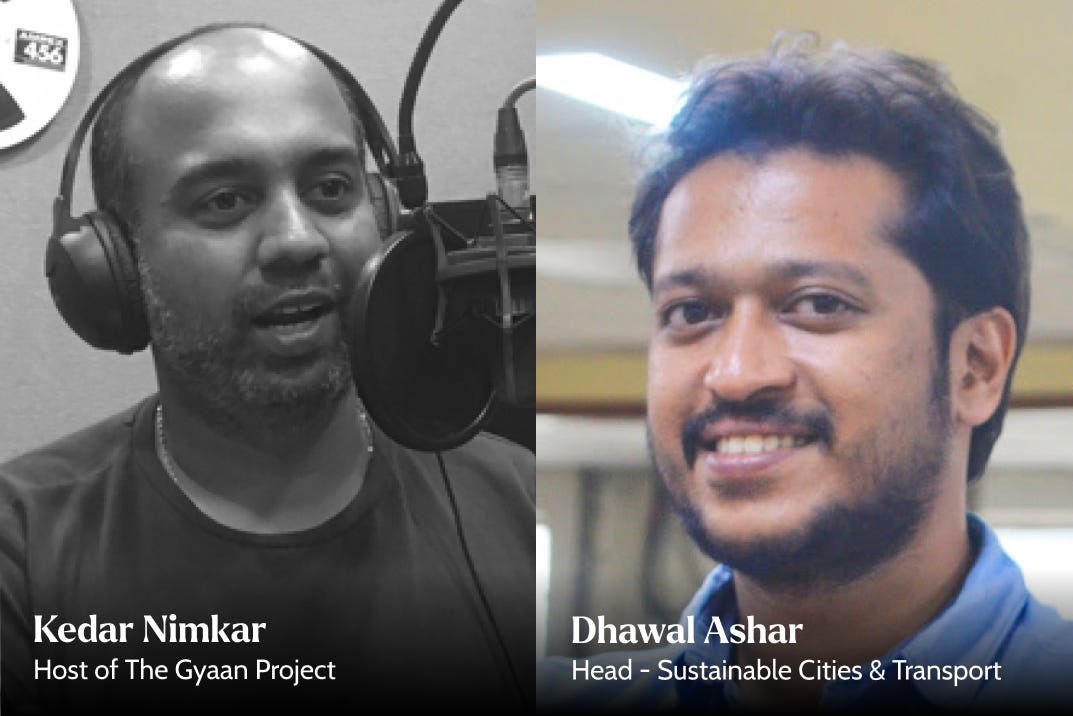
Dhawal Ashar is a Head of Sustainable Cities & Transport program at WRI, India. His work integrates transport engineering and urban design to improve safety and sustainability in cities. The following SamaChar has 4 interesting questions and answers from the main episode. Know how Mumbai moves, how transport planning process happens, why do we have traffic jams and hopeful future of Mumbai’s transport design.
It’s an essential read for designers, planners, students, and citizens who care about cities. Listen to the full episode and share it with friends, family, and design and art communities.

1️⃣ How does Mumbai travel?
In short
51% on foot.
In detail
First let me explain what a trip is. Assume you are going from your house to office on a train - thats one trip. (your return journey is another trip). This trip has 3 legs. First leg, from your house to station, then your train journey and third is from station to office. You can walk, get an auto, ride a bike - That doesn’t matter.
We are looking at over 15 million trips that the city of Mumbai makes each day. I am quoting this from a study that BMC did in 2014 called the Comprehensive Mobility Plan. About 70%+ commutes by the train. Then you have the BEST, followed by IPTs - taxis, auto rickshaws and now the Ubers and Olas, followed by motorcycle, followed by car. All of this is just the motorised trips. The study estimated that about 51% of all trips in Mumbai happen on foot. Personal automobiles are 5-7% of all trips that happen in Mumbai. So largely this is how Mumbai travels.
2️⃣ How does transport planning process happen?
In short
Surveys, mapping and projections.
In detail
Transport planning is a four step process. Trip generation, trip distribution, mode split and trip assignment. We do surveys, go to households and ask people about their daily trips. This is what we call a trip diary. That becomes our base model of what is happening right now. It tells us how many trips are being made and why they are being made.
Based on that, we do projections based on many scenarios. We then assign trips to every link (road). We know the capacity of that road and we also know the volume on that road. When the volume is more than the capacity, then that is a jam. That is how problems get identified.
For smaller projects, we do a traffic impact assessment. For city level studies, we divide the city into zones. This entire process helps us understand where pressure exists and where interventions are required.
3️⃣ Why is there so much traffic on Indian streets?
In short
We are loosening the belt than becoming healthier.
In detail
First, we put traffic signals. When jams go past the previous signal, we make the road one way. Many roads in Pune and Bangalore became one ways for this reason. When one way gets saturated, we build a flyover. When the flyover gets saturated, we build another flyover on top. But thats not solving the problem. We are worsening it. We are loosening our belt as we keep growing inches. We are not figuring out ways to become healthier. At some point, we need modal shifts.
We have to figure out ways to get people out of their cars, and make them use some form of public transport. Decision making, should be driven by whether we care about moving cars or we care about moving people.
4️⃣ What gives you hope for Mumbai’s transport future?
In short
Walking population.
In detail
One thing that makes me very hopeful is that majority of Mumbaikar’s walk. We will have to transform at some point soon. Every city in Europe has gone through these phases at some point in the fifties and the seventies. It is not like they were pedestrian friendly cities always. Everyone had an automobile peak at some point. But then through well documented strategies and changes, they have become more walking friendly now - the best destinations for travel. It is not uncommon to go to Paris and walk 10KMs a day.
What gives me hope for Mumbai is that we know what the problem is. We have enough experience to provide solutions are fairly low cost. We are seeing a lot of focus on public transport and metro construction. Hopefully, in a decade from now, we should be in a much better place.
If you wish to listen to more details, here are links to the full 60 minutes fun conversation - Youtube | TGP Website | Spotify | Apple Podcast
Let me know what stood out to you the most in the comments section. TGP has been labour of love since 2016 and I would highly appreciate if you can share this to as many people in your network. The subscriber count isn’t increasing and I need your help.
Stay tuned for more SamaChar and episodes from The Gyaan Project!