


Graham’s Hierarchy of Disagreement is an informal ranking of seven common strategies of dissent, from the lowest-quality forms of disagreement to the highest. It was developed by Paul Graham in his essay How to Disagree.
Paul’s reason for writing the piece seems little ahead of it’s time. The web had made the writer-reader relationship far more interactive (and he was right). As a result, disagreement through the written word, in the form of online comments, surged. While having ideas challenged is wonderful, it’s worth developing a nuanced understanding of what quality agreement and disagreement actually look like.
This dynamic has been further amplified by WhatsApp forwards and groups. In India, common themes of argument include caste, reservations, violence, politics, and religion, among others. One recurring debate is about cutting trees and deforestation.
In this post, I’ll take “deforestation” as the subject and illustrate Graham’s hierarchy using common arguments from both sides, the kind you’ll find in WhatsApp groups and other online forums.
The idea is to help you identify where you sit on the pyramid when making your case, and to calibrate the quality of your arguments over time.
Below is the main template, followed by examples from those who argue that deforestation and tree cutting are necessary for development, and then from those who argue that deforestation reflects a myopic view of progress.
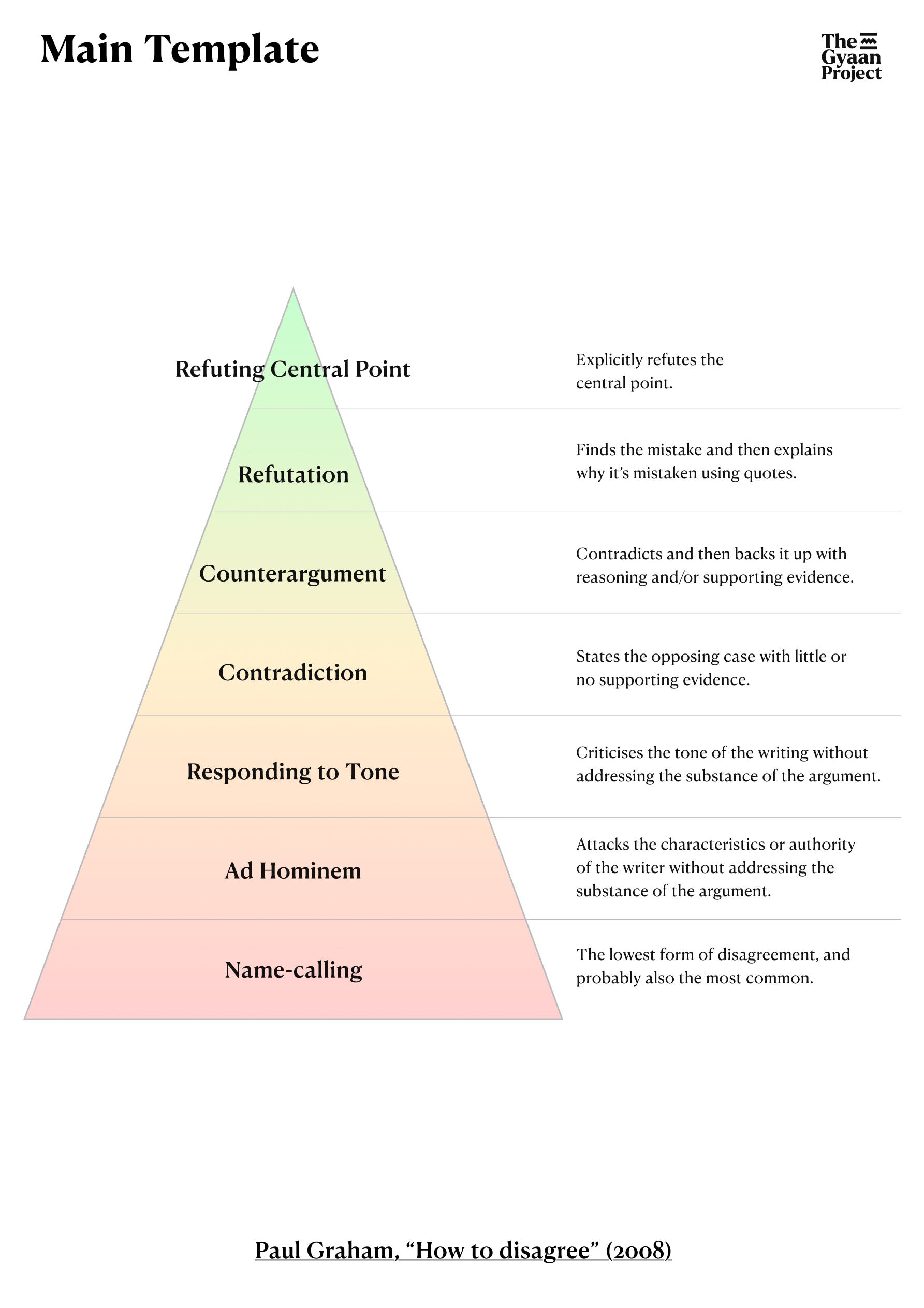
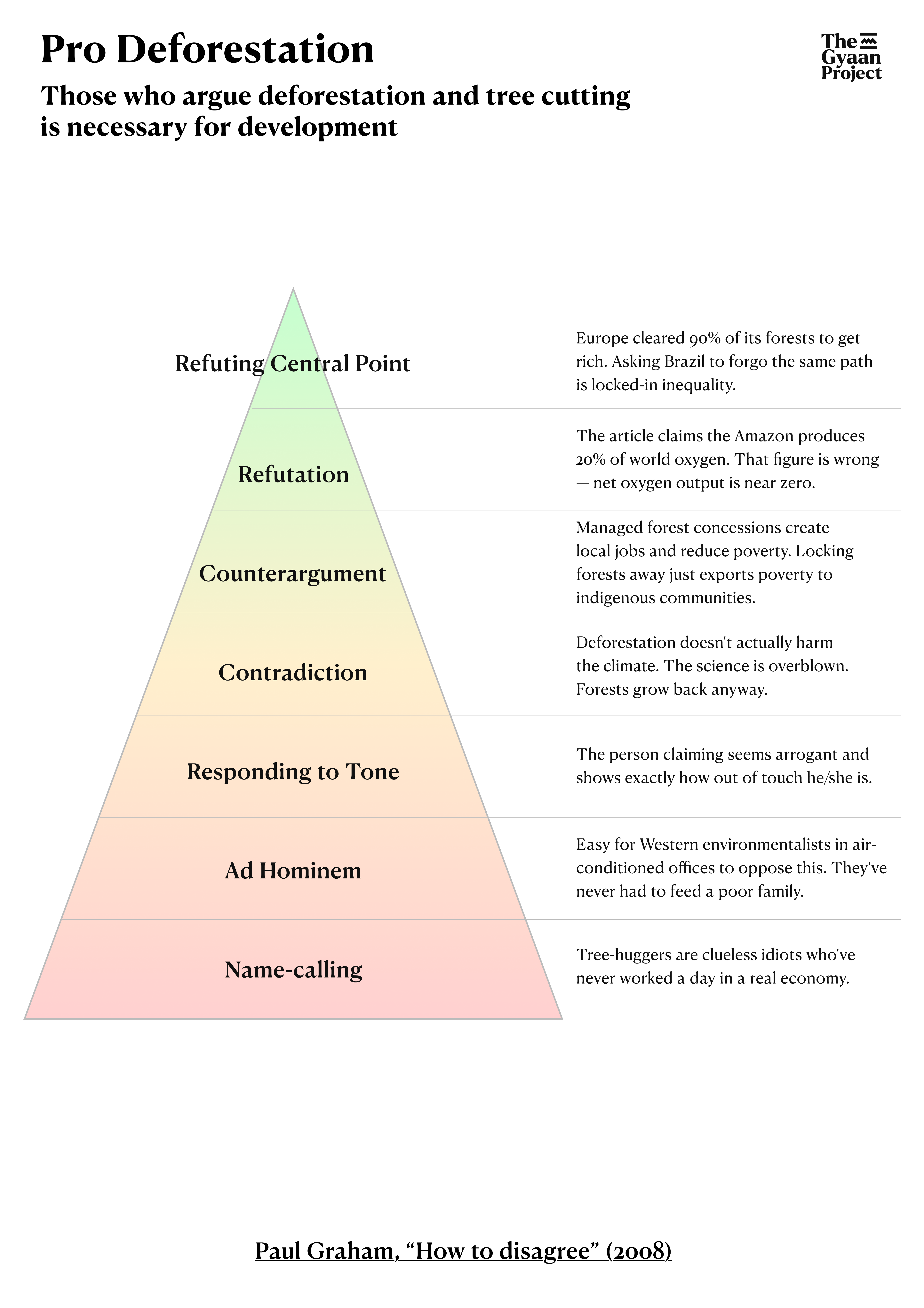
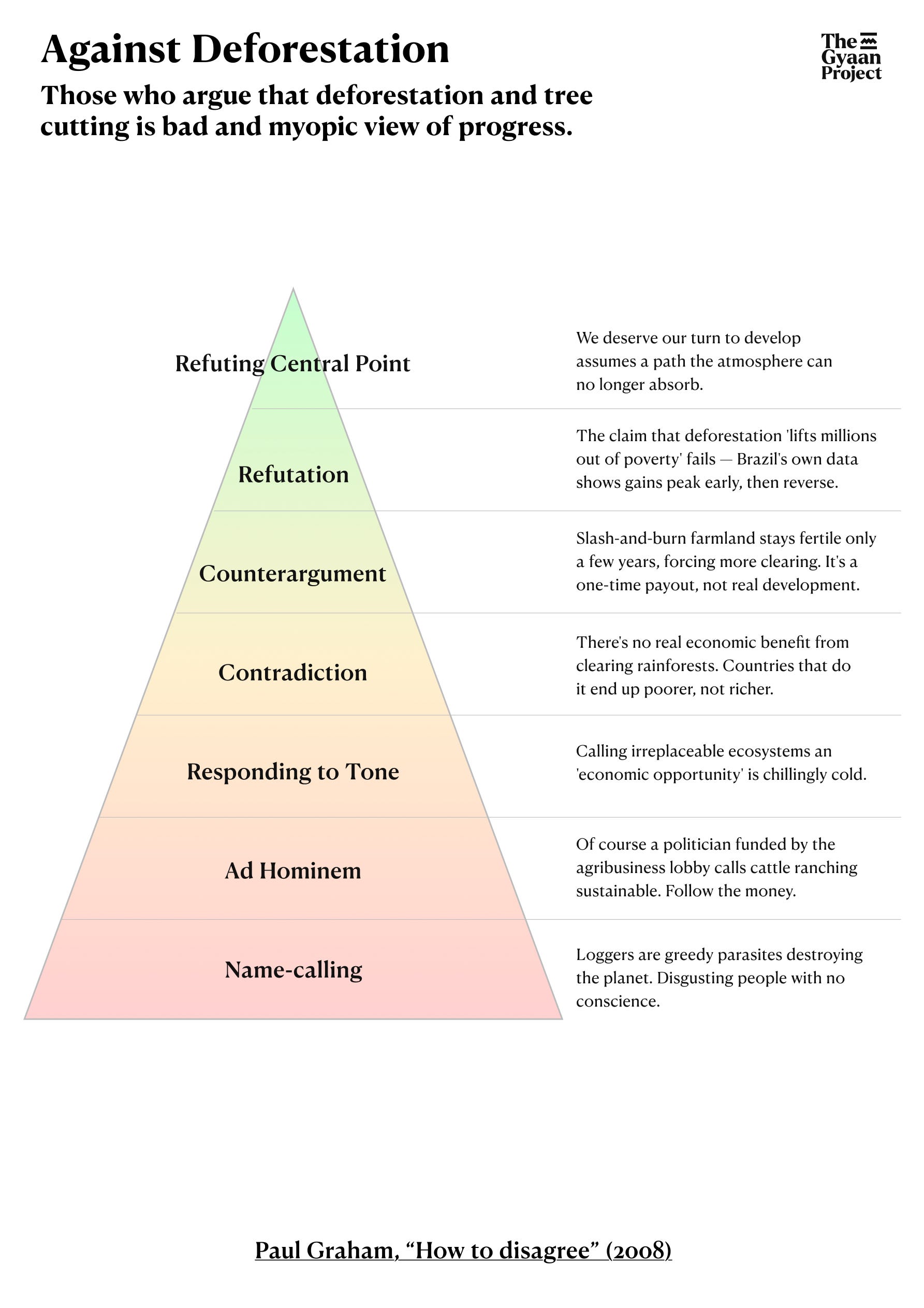
Now we have a way of classifying forms of disagreement. What good is it? One thing the disagreement hierarchy doesn't give us is a way of picking a winner. The levels merely describe the form of a statement, not whether it's correct. A “Refuting central point” response could still be completely mistaken.
But while these levels don't set a lower bound on the convincingness of a reply, they do set an upper bound. The most obvious advantage of classifying the forms of disagreement is that it will help people to evaluate what they read. In particular, it will help them to see through intellectually dishonest arguments. By giving names to the different forms of disagreement, we give critical readers a pin for popping such balloons.
Such labels may help writers too. Most intellectual dishonesty is unintentional. Someone arguing against the tone of something he disagrees with may believe he's really saying something. Zooming out and seeing his current position on the disagreement hierarchy may inspire him to try moving up to counterargument or refutation.
But the greatest benefit of disagreeing well is not just that it will make conversations better, but that it will make the people who have them happier. If you study conversations, you find there is a lot more meanness down in the first level than up in top most level. You don't have to be mean when you have a real point to make. In fact, you don't want to. If you have something real to say, being mean just gets in the way.
If moving up the disagreement hierarchy makes people less mean, that will make most of them happier. Most people don't really enjoy being mean; they do it because they can't help it.
You can find all 3 PDFs here in case you’d like to forward, download, or print them. If you enjoyed this post and would like one for politics in India, religion, communal hatred, or other topics, let me know in the comments. Happy to make more.