


Welcome to SamaChar - A newsletter from The Gyaan Project podcast that brings you char (4) insightful Q&A from the past episodes. This week we revisit our episode 201 with Architect A Srivathsan released in Nov 2020 - Designing temples.
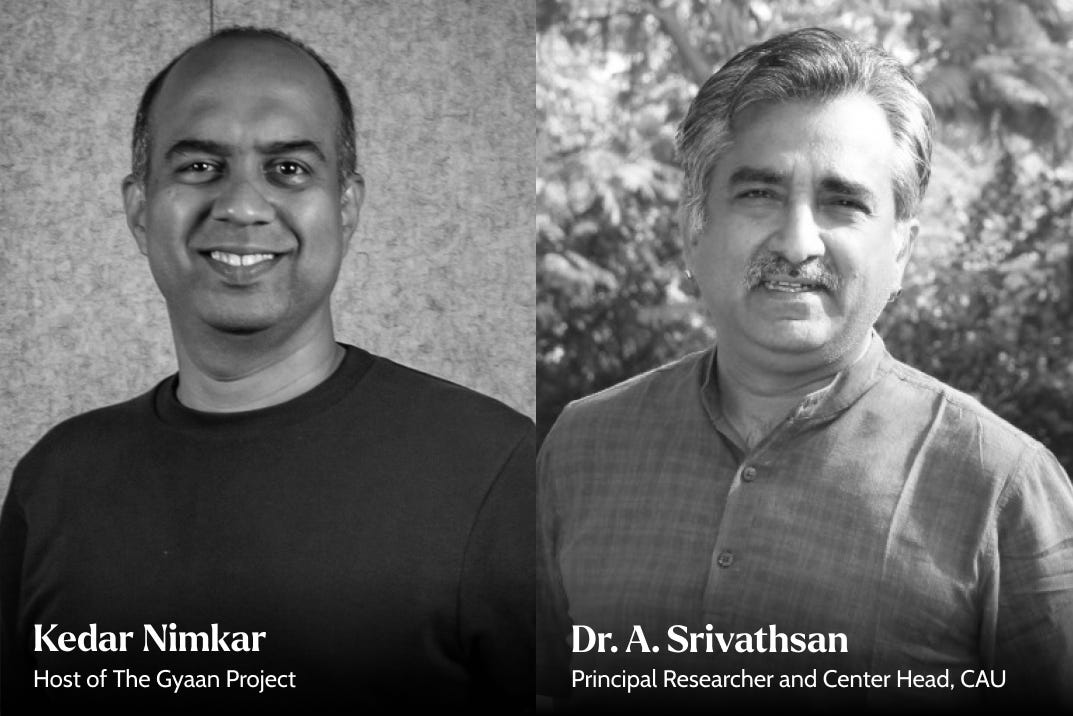
Dr. A. Srivathsan is an architectural scholar with more than twenty-five years of experience. Before joining his role as the Executive Director of CAU, Srivathsan served as the Academic Director of CEPT University for five years. He holds a Ph.D. from the Indian Institute of Technology along with a Master’s degree in Urban Design, School of Planning and Architecture, New Delhi.
We spoke about Ram Mandir’s architecture in Ayodhya. There are 2 main issues with it’s architecture. First, it’s more of a political project than a religious project. Thats why we see South Indian, Eastern and Northern styles fused together in the architecture. This is to appeal to larger national group of Hindus - so there is nothing new or inspiring in the design. Second, it’s built on a problematic site where you can not erase the history of demolition and fights. Even if you ignore the politics and look at it purely as design, much better could have to done.
Following are 4 Q&A from my conversation with him around design of contemporary sacred spaces, mainly the Hindu temples. This is a must read for architects and anybody interested in design.

1️⃣ If temples are public spaces, why exclude certain people?
Short answer:
Open doors, closed minds.
Long answer:
Theoretically, all temples are public spaces and open to everyone. That is the common perception. But the reality on the ground is very different. The Travancore temple was among the first to open temples for various castes, and that was only in 1936. In Vaikom (Kerala), it was a struggle to get even the streets around the temple open for people. Gandhi accepted to inaugurate the Lakshmi Narayan temple in Delhi in 1939 on a condition that it will be open to everyone, including Dalits. But the architecture itself didn’t have physical blocks. These prohibitions are social prohibitions, which are far more powerful. The upper castes having complete control on lower castes, men having control on women, that is the most effective restriction. Architecturally speaking, there were no devices. The walls were inside people’s heads. And that struggle continues even today.
Is it good to ban non-Hindus from entering temples? Let me know what do you think in the comments section.
2️⃣ Why are temples so ornamental?
Short answer:
To tell stories.
Long answer:
Ornament is not to be viewed as we now view it, as some extra thing, some excess that is embellished after building and can be removed if you don’t need it. Ornament traditionally is very much part of completion. Without the ornament, a building will not be complete. It plays multiple roles. At a simple level, it helps you tell a story. It is part of the narrative. But at another level, these are not only symbols of prosperity, they are that itself. Even in a traditional residence, at the entrance you would find elements which to an ignorant eye will look like ornamentation. But those are the ones which produce a sense of wellbeing into that house. They are not superfluous. So in traditional temples, ornaments are not decoration. They complete the building. Remove the ornament and the temple is incomplete.
Out of 7,50,000 registered temples in India, which is your favourite?
3️⃣ Which is the most sacred material to build temples?
Short answer:
Stone was for the dead.
Long answer:
There is a very interesting history here. The most preferred material according to traditional texts is not stone as we now think of it as the best and most expensive material. The most preferred material is wood. Then followed by stucco, brick and stucco. Stone comes later. In fact, some archaeologists think stone was actually a taboo. At least in South India (which I am more familiar with), stone was associated with funeral rites. For a long time it was not used. Much later, post sixth or seventh century, stone became a preferred material. Same goes with the deity’s idol as well. So materials have changed over time. This pattern was certainly prevalent in South India, but since some of the original texts trace their origin to Kashmir and the north, it would have had a wider prevalence. Currently, for various reasons, concrete is the most common material in temple construction.
Praveen Mohan’s Youtube Channel is great in decoding ancient religious architecture.
4️⃣ How are contemporary architects innovating in temple design?
Short answer:
Perforated walls, radical temples.
Long answer:
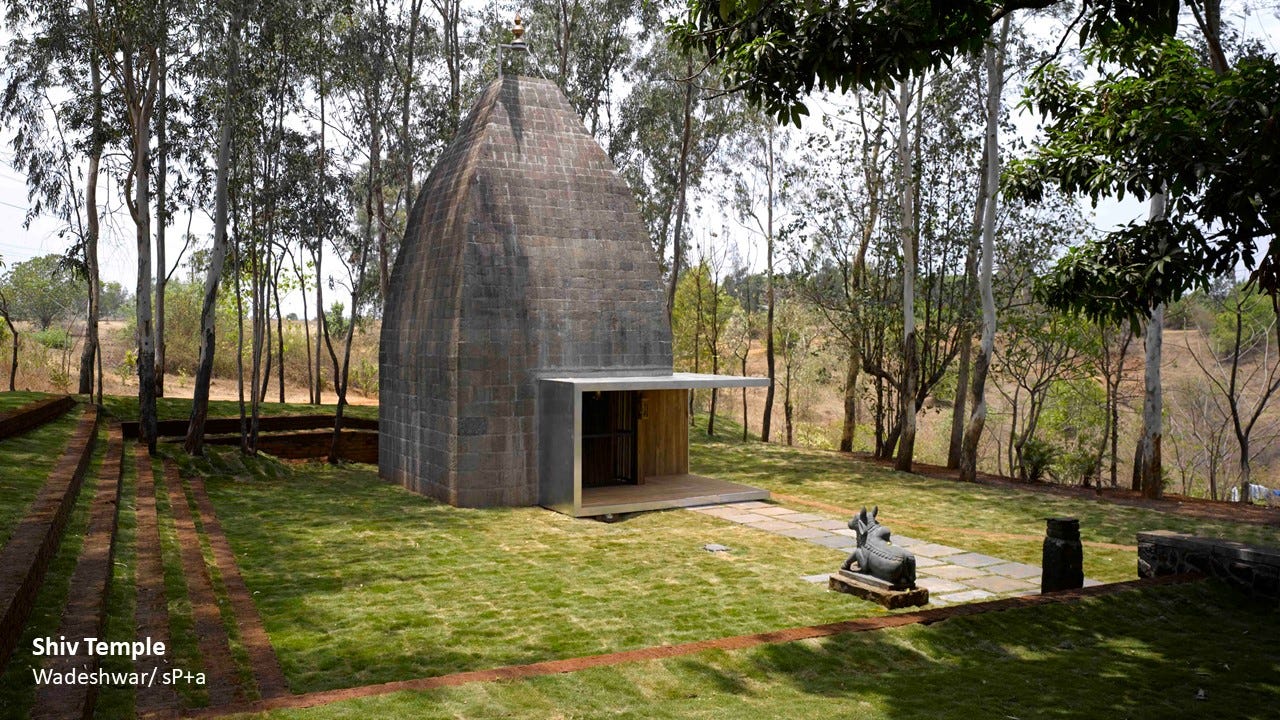
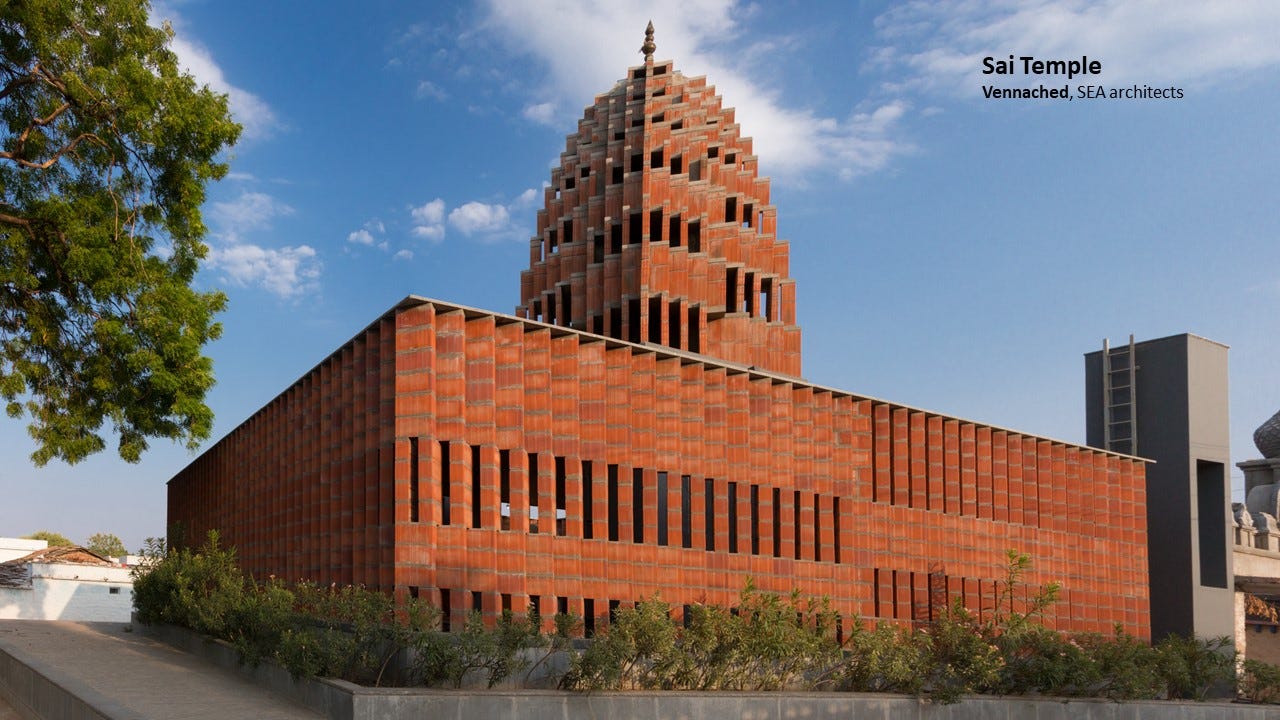
I have looked at eight to nine temples built in recent times and each architect has adopted different strategies. For instance, Sameep Padora (from SPA) designed a Shiva temple where the Shikara and sanctum are fused into one monolithic structure without any ornamentation. Unlike a traditional temple where the top is closed, he opens it out for sunlight. It sits beautifully in the landscape and local citizens have embraced it. Then there is a temple near Hyderabad designed by a young architect S. Krishna. He used long bricks turned around to create a very abstract Shikara. But his most important move is that he perforated the boundary wall. Normally that wall separates sacred space from the outside. You never perforate that. But he did. You can see the temple inside and the village tree outside where people gather. He is redefining the temple as an extended social space.
An amazing talk and list of modern temples from an architecture’s lens at Studio Matter’s Frame 2019
If you wish to listen to more details, here are links to the full 50 minutes conversation with Dr. A. Srivathsan

TGP has been labour of love since 2016 and I would highly appreciate if you can share this to as many people in your network. The subscriber count isn’t increasing and I need your help.